






Como a IA pode ajudar você a iniciar uma pequena empresa hoje
26 min to read
- Adopt AI immediately to avoid a widening competitive gap
- Transition from productivity tools to strategic AI ecosystems
- Execute a structured 90-day rollout for sustainable success
Delaying AI integration can result in a 15% loss of market share and significantly higher operational costs compared to early adopters who are already seeing a 347% average ROI.
Use a combination of multimodal AI, autonomous agents, and specialized tools like Claude or Shopify Magic to transform your business from simple task automation to high-level strategic growth.
Follow a phased plan of assessment, integration, and optimization to ensure your team is trained and your AI workflows are generating measurable returns on investment.
As everyone knows, Artificial Intelligence (AI) is not a “thing of the future” anymore. It is now one of the main factors for a business to keep its competitiveness. Companies that incorporate AI in their operations today will be the ones to dominate the market tomorrow. And those who postpone it are taking a risk of losing their position in the market.
Índice
Why small businesses need to embrace AI today
The adoption rate of AI has significantly changed within the last two years. Many cutting-edge capabilities in 2023 are now standard practice. Small businesses that do not adopt AI are feeling the distance between them and their competitors getting bigger day by day. You don’t believe it? Check some numbers:
– 78% of small businesses using AI report higher productivity
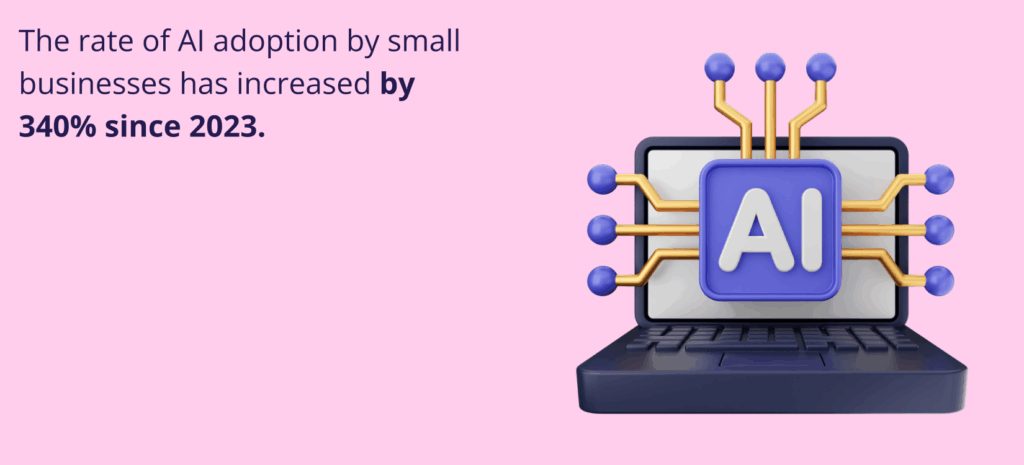
– The rate of AI adoption by small businesses has increased by 340% since 2023
– The revenue of early adopters is 23% higher than that of their competitors
– Businesses utilizing AI are 67% more likely to face economic downturns successfully
AI in 2026: What is really happening
Many AI features that were close to sci-fi scenarios and hardly imaginable a few years ago are now available, affordable, and easy to use, and they have a remarkable business impact.
Let’s see how far we’ve come since 2023:
– AI Agents: Autonomous assistants can handle different tasks of the workflow, e.g., scheduling and reporting.
– Multimodal AI: The technology that can recognize text, pictures, audio, and videos is the future for getting to the ground of any topic.
– Real-Time AI: Instruments can decide on a business move based on the latest data.
– AI Video Generation: In just a few minutes, you can make top-notch video content without a technician.
– Voice Cloning: Create highly targeted audio content rapidly and cheaply for marketing or customer engagement.
– AI Code Generation: Develop apps or software without manual coding.
The modern AI ecosystem includes:
- Integration APIs: Easily connect multiple tools and systems.
- AI-First Platforms: All-in-one solutions powered entirely by AI.
- Marketplaces: Essential centralized hubs where users can find and access various specialized AI tools and services.
- Análise: Simplify complex data to reveal metrics that can be used for business optimization and ROI tracking.
Initially, AI was a mere productivity tool, but it has now become a strategic partner. The tools are ready – the only question is how quickly your business will adopt them.
The real impact of AI on businesses: By the numbers
AI is not just improving workflows – it is transforming the very performance of businesses.
Small Business AI Usage (2025):
– Average ROI: 347% during the first year.
– Revenue increase of 31% for AI-powered companies.
– Employees save 15–20 hours per week due to automation.
– The company’s operating expenses have been lowered by 23%.
– 89% of small businesses are committed to increasing their AI investment in 2025.
The “Cost of waiting”
The decision to defer AI implementation can be quantified in terms of lost opportunities and risks. Companies that delay AI integration are likely to lose up to 15% of their market share to competitors who are already using AI. They also tend to spend about 40% more on traditional operations and marketing, while their overall growth rate remains three times slower. In addition, customer acquisition becomes significantly less efficient, with costs that can be 67% higher than those of AI-driven companies.
Essential AI tools for small business success
AI website & E-commerce builders
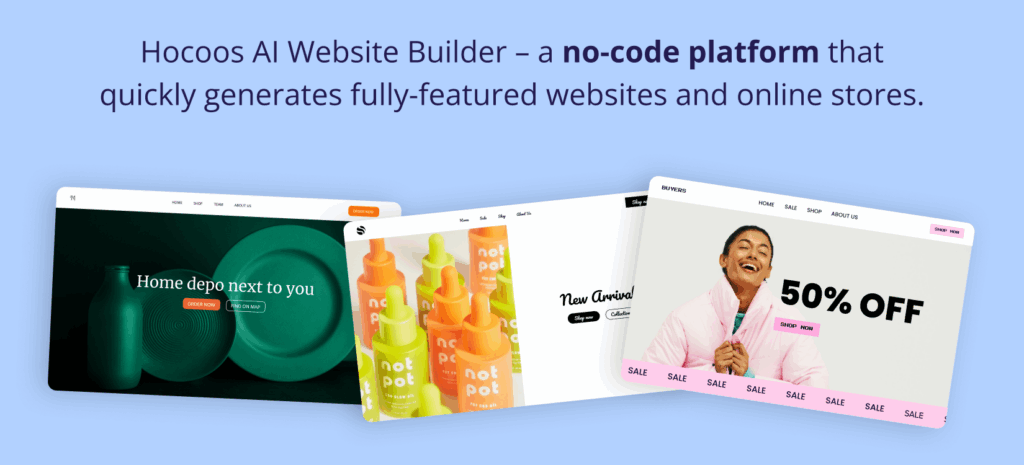
– Hocoos AI Website Builder – a no-code platform that quickly generates fully-featured websites and online stores. The main features include AI-optimized design, automated SEO, multilingual support, and real-time analytics. (ROI: Up to 300% in six months for service-based businesses, online shops, and portfolios.)
– Shopify Magic – a seamlessly integrated feature in Shopify that creates product descriptions, customer behavior prediction, promotion optimization, and inventory management automatically. (ROI: Around 250% within eight months for most users.)
AI content creation & marketing
– Claude 3.5 Sonnet (Anthropic) – generates and analyzes long-form content, data visualizations, and code in multiple languages and formats. (Custo: $20/month. ROI: 400% average return.)
– Jasper AI – an assistant that can be used for automating the generation of blogs, emails, ads, and social media content while keeping the brand voice consistent. (Custo: $49/month. ROI: 280%.)
– Runway ML – creates videos from the text, changes visuals by itself, and keeps brand consistency across the campaigns. (Custo: $12/month. ROI: 350%.)
AI business intelligence & analytics
– Tableau AI – breaks down the complicated data into simple insights, makes predictive reports, and keeps an eye on live metrics. (Custo: $70/month per user. ROI: 320%.)
– Microsoft Copilot for business – an AI assistant in Word, Excel, and Teams that records meetings, writes emails, and does data analysis in a fast and easy way. (Custo: $30/month per user. ROI: 290%.)
AI customer service & support
– Intercom AI – provides customer support through automated chatbots, ticket routing, sentiment tracking, and engagement without intervention. (Custo: $39/month. ROI: 380%.)
– Zendesk AI – handles support from various channels with the help of predictive answers, detailed analytics, and workflow optimization. (Custo: $55/month. ROI: 310%.)
AI social media & marketing automation
– Hootsuite AI – finds the best time for posting, predicts engagement, and analyzes the competitor’s activities, ready for the planning of a campaign. (Custo: $49/month. ROI: 260%.)
– Buffer AI – generates captions, schedules posts, and tracks performance metrics to improve marketing results. (Custo: $6/month per channel. ROI: 240%.)
Industry-specific AI applications
AI is transforming diverse industries, to be exact, every industry, but with a varying impact, depending on the manner of its application. Here is a brief overview of how popular sectors implement AI to generate tangible results:
E-commerce & Retail
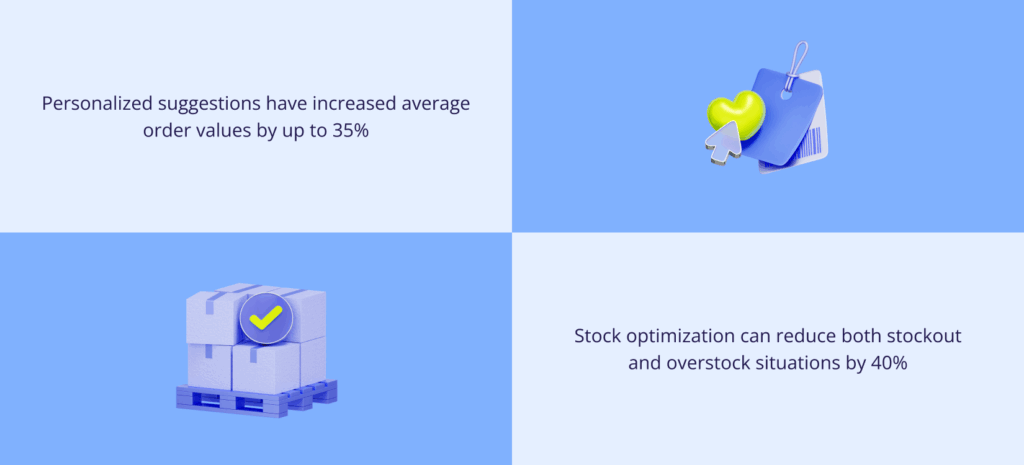
AI-powered tools are changing the way online shops work. For instance, real-time price adjustment systems can consider factors such as demand, stock levels, and competitor prices. Just as personalized suggestions have increased average order values by up to 35%, stock optimization can reduce both stockout and overstock situations by 40%. AI-powered customer service automation enabled chatbots to offer services round the clock with an outstanding 95% accuracy rate.
Success story: TechGear Store enhanced its revenue by 67%, with the average order value going up from $89 to $134 in six months.
Professional services
AI is also transforming the way professional service firms handle their work. One can achieve an 80% reduction in manual handling time through document automation. AI assistants can “smooth” client communication by setting up meetings and, without the need for a human, sending the reminders. The use of AI in project management entails that it keeps track of the work done and updates tasks in real-time, while billing and invoicing tools are a 99% accurate support system for the financial record-keeping.
Exemplo: LegalTech Solutions reduced administrative time by 70%. It is creating a 45% increase in billable hours and lawyers being more client-oriented.
Healthcare & Wellness
Artificial intelligence is a major player on the operational side of healthcare, and, at the same time, it is a significant leap in patient care. For instance, artificial scheduling systems can lessen double booking of appointments by 60%, and automated medical record management is always up-to-date as it is freshly updated from transcription and analysis of the real-time conversations between patients and doctors. AI-supported treatment plans aim for clinicians to make decisions backed by evidence and based on the most recent research, while automated billing and claims are making the financial side of the business much easier.
Effect: WellnessPlus Clinic has raised patient satisfaction levels by 52% and reduced administrative costs by 38%.
Education & Training
Artificial Intelligence is practically reinventing the entire process of students learning and faculty teaching. AI-powered personalized learning systems tailor the content to each student’s individual learning style and speed. Simultaneously, automated grading can be responsible for reducing instructors’ workload by 90%. Moreover, AI can be effective in the quick creation of quizzes, notes, and study guides. If AI tutoring is used, students can get the academic help they need immediately, which means that it is possible at any time, even at night.
Impacto: EduTech Academy has increased the course completion rate by 43% and lowered the instructor workload by 55%.
Your 90-Day AI action plan
Assessment & Strategy (Days 1–30)
- Identify challenges AI can solve and select 2–3 high-impact areas.
- Set measurable success metrics (ROI, time saved, revenue growth).
Implementation & Training (Days 31–60)
- Automate repetitive processes: content creation, scheduling, and data entry.
Optimization & Scale (Days 61–90)
- Refine AI workflows, expand across departments, and monitor ROI.
- Analyze reports, fine-tune models, integrate additional tools, and reinvest savings.
ROI & Other Impact Metrics
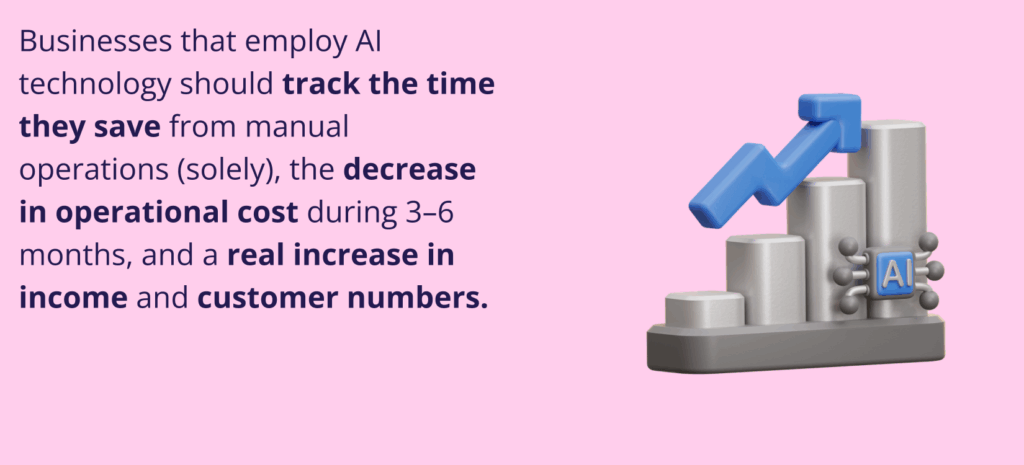
To accurately measure AI’s impact, you must consider qualitative aspects. First, businesses that employ AI technology should track the time they save from manual operations (solely), the decrease in operational cost during 3–6 months, and a real increase in income and customer numbers. Another metric you can’t ignore is productivity per employee. Additionally, satisfação do cliente can be included (NPS scores or direct feedback).
Advanced Approaches for Small Businesses
1) AI Automation Workflows. Connect AI tools to automate end-to-end processes. An example of utilizing “draft, approval, automatic posting.”
Platforms: Zapier, Microsoft Power Automate, and IFTTT.
2) Predictive Analytics. Forecast sales, market shifts, and customer behavior.
Tools: Tableau AI, Power BI with Copilot, Google Cloud AI.
3) Personalization. Deliver hyper-personalized campaigns and content. Engagement often increases 40–60%.
Tools: ActiveCampaign, Klaviyo AI, and HubSpot AI.
How to keep your AI strategy “Future-ready”
Businesses that employ AI as a continuous process of evolution will be the market winners. Instead of seeing it as a threat, companies can experience innovation as an opportunity by supporting their team’s continuous learning through webinars, tutorials, or case study participations. Your brand voice can be reflected by utilizing custom AI solutions, which can also meet your operational needs while monitoring regulatory changes such as privacidade de dados, GDPR, and AI transparency standards.
It is better not to “put all your eggs in one basket”. It is possible to distribute the risk of being heavily dependent on a single tool or provider by using different AI applications in various departments. What’s more, by being flexible through continuous evaluation of your objectives and adjusting your tactics, you will have the capacity to respond to market changes.
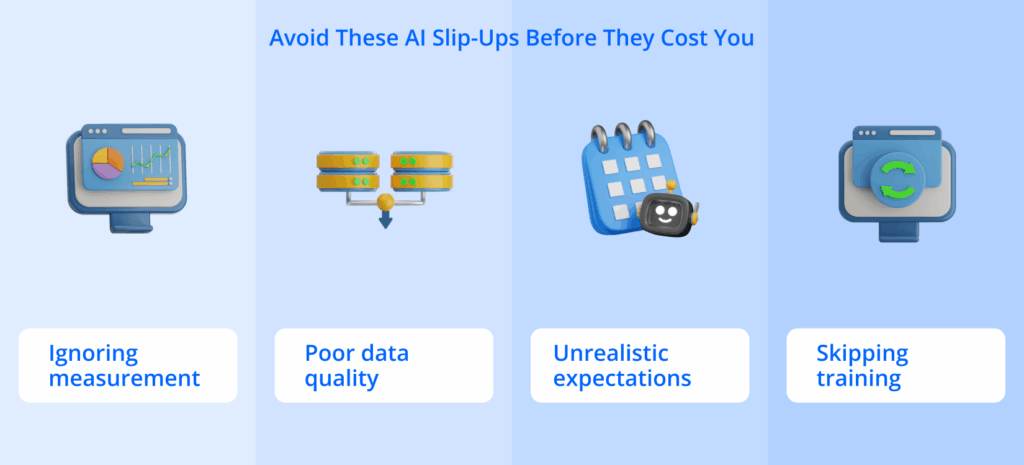
Avoid these AI slip-ups before they cost you
– Ignoring measurement: It is crucial to have clear KPIs from the very first day to track progress and demonstrate the impact.
– Poor data quality: The AI system will be less efficient if the data it receives is of poor quality. Ensure that your input is not only accurate but also complete and nicely structured.
– Unrealistic expectations: Always consider that AI helps human strategy, it doesn’t substitute it. Make precise and attainable plans, and be realistic.
– Skipping training: The team is key to operating AI properly. Thus, don’t think you can skip the correct introduction and continuous support for them.
Considerações finais
The AI revolution is no longer a matter of “when” – it is already happening. Use the proper tools, create a thoughtful plan, and be open to learning to develop a business that is more capable, efficient, and sustainable over time, and one that can flourish in the constantly evolving digital world.
Would you like to see more entrepreneurs taking the first step on the AI journey? Then share this guide with them!
Perguntas frequentes (FAQs)
Is AI still affordable for a very small business with a limited budget?
Yes, the rise of “inference economics” has significantly dropped the cost of AI, with many comprehensive platforms offering entry-level tiers for under $20 a month. For example, Hocoos provides a “Premium” plan at $15 per month that includes hosting, e-commerce, and marketing tools in one package.
How do I know which AI tool to choose when there are so many options?
Focus on identifying your biggest operational bottleneck—such as customer scheduling or content creation—and select a specialized tool that integrates with your current workflow. If your primary need is a professional web presence, a tool like Hocoos simplifies the choice by generating a full site based on just eight questions about your business.
Will using AI make my business feel impersonal to my customers?
When used correctly, AI increases personalization by analyzing customer data to provide hyper-relevant recommendations and faster response times. You can use platforms like Hocoos to maintain a consistent brand voice across your site and blog, ensuring that automated content feels authentic rather than robotic.
What is “Agentic AI” and why should a small business care?
Unlike standard chatbots that just answer questions, AI Agents can execute multi-step workflows like researching leads, drafting proposals, and scheduling follow-ups. In 2026, these agents serve as a “silicon workforce,” allowing small teams to handle a volume of work that previously required a much larger staff.
Do I need to hire a technical expert to implement AI?
Most modern AI platforms are “no-code,” meaning you can set them up using natural language instructions instead of programming. For instance, Hocoos allows you to build and launch an entire service-based or retail website without any coding or design skills required from your team.
What is the biggest risk of waiting to implement AI?
The “cost of waiting” is now measurable; companies delaying adoption are seeing customer acquisition costs rise by up to 67% compared to AI-driven competitors. Beyond costs, you risk falling behind in operational speed, as tools like Hocoos can launch a content-ready website in minutes, whereas traditional methods still take days or weeks.

SIGA-NOS
-
The 8 Technology Trends Reshaping Business in 2025
24.10.202515112 visualizações -

Prosperando no Mercado Digital: Como ganhar dinheiro e viver online
21.04.202313790 visualizações -

A Revolução da IA Chegou e as Pequenas Empresas Nunca Mais Serão as Mesmas
24.02.202313235 visualizações


-
The 8 Technology Trends Reshaping Business in 2025
24.10.2025The future isn’t just approaching – it is unfolding all around us. While we...15112 visualizações -

Prosperando no Mercado Digital: Como ganhar dinheiro e viver online
21.04.2023Você está pensando em ganhar uma renda extra, mas não tem ideia de onde...13790 visualizações -

A Revolução da IA Chegou e as Pequenas Empresas Nunca Mais Serão as Mesmas
24.02.2023A inteligência artificial costumava ser coisa de ficção científica – robôs assassinos rebelando-se...13235 visualizações