






What Are the Individual Components of the 4Ps (Product, Price, Place, and Promotion)?
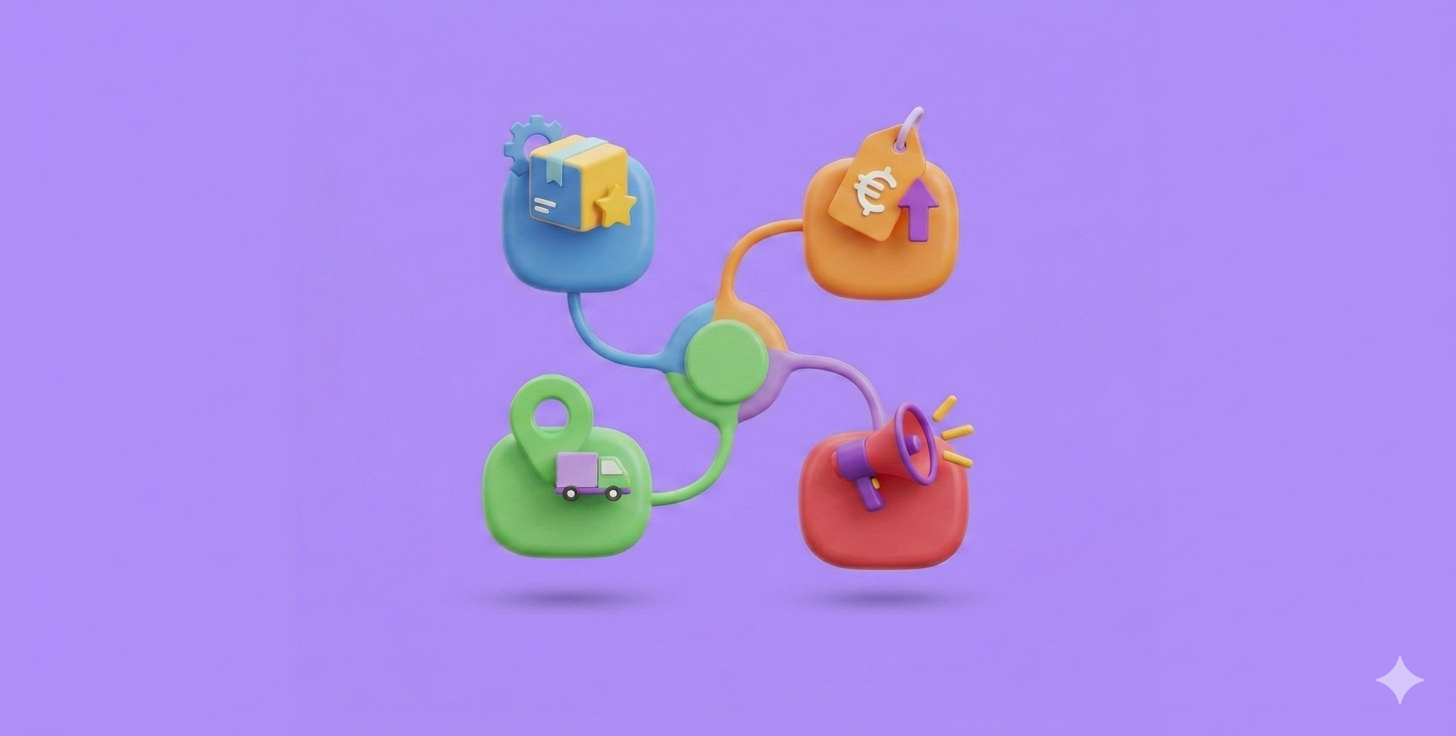
The 4Ps define the four levers every marketer controls. First introduced by E. Jerome McCarthy in 1960, each element shapes the customer experience and influences the others.
- Product – What you’re selling: design, features, quality, and branding
- Price – Your pricing strategy, discount structures, and the value you signal to buyers
- Place – The distribution channels through which your product reaches customers
- Promotion – Every communication that drives awareness or sales: ads, PR, social media, email
- Interdependency – Change one P and the others are affected; a premium price demands a premium product and placement
Real-life examples:
- Apple prices iPhones at a premium, sells through exclusive channels, and promotes with minimal campaigns — every P reinforces the same brand story.
- A local bakery prices competitively, sells at farmers’ markets, and promotes on Instagram to reach nearby customers.
How Have the 4Ps Evolved Into the 7Ps for the Service Industry?
When applied to services — where the experience is the product — three new Ps were added: People, Process, and Physical Evidence, forming the 7Ps.
- People – Every human touchpoint: sales reps, support agents, frontline staff
- Process – The systems and workflows that deliver your service reliably
- Physical Evidence – Tangible signals of quality: a clean space, a polished app, professional packaging
A hotel can’t separate its “product” from staff attitude, check-in speed, or lobby atmosphere. For service businesses, these three Ps are just as critical as the original four.
What Is the Difference Between the 4Ps and the 4Cs (Customer-Centric Mix)?
The 4Cs, proposed by Robert Lauterborn in 1990, reframe the same decisions from the customer’s point of view rather than the business’s.
| 4Ps (Business View) | 4Cs (Customer View) |
| Product | Customer solution |
| Price | Cost to the customer |
| Place | Convenience |
| Promotion | Communication |
Neither model replaces the other — they’re most powerful when used together.
How Do You Develop and Balance a Successful Marketing Mix from Scratch?
Start with your customer, not your product. Define who you’re targeting and what they need — then build each P around that foundation.
Step-by-step tips:
- Define your audience first – Know their needs, habits, and pain points before anything else
- Align price with positioning – Your price signals value; make sure it matches how you want to be perceived
- Choose channels where your customer already is – Meet people where they shop or browse
- Build promotion around one core message – Then adapt the format for each channel
- Test one variable at a time – Changing multiple Ps at once makes it impossible to know what’s working
Key considerations:
- Budget constraints limit what’s feasible across all four Ps at once
- Competitive pressure may force reactive adjustments to price or promotion
- Customer feedback should continuously inform how you rebalance the mix
What Are the Common Pitfalls to Avoid When Aligning the 4Ps?
The biggest mistake is misalignment. A premium product sold through discount retailers sends a confusing signal. Heavy promotion without a clear distribution strategy creates interest with nowhere to go.
| Pros | Cons |
| Creates a coherent brand perception | Requires cross-functional coordination |
| Increases conversion efficiency | A change in one P ripples through the others |
| Easier to measure and optimize | Can become rigid in fast-moving markets |
| Builds long-term customer trust | Demands ongoing investment to maintain |
How Does the Marketing Mix Integrate Into the Overall Marketing Plan?
The 4Ps are the execution layer of a broader marketing plan — the plan defines what you want to achieve, and the mix defines how. Once positioning is set, marketers track KPIs tied to each P:
- Product/Price → sales volume, average order value, margin
- Place → channel conversion rates, distribution reach
- Promotion → campaign ROI, reach, engagement, cost per acquisition
How Has the Marketing Mix Changed in the Era of AI?
AI is reshaping all four Ps at greater speed and scale than ever before. The framework hasn’t changed, but the tools have.
- Product – Recommendation algorithms personalize what each user sees
- Price – Dynamic engines adjust rates in real time based on demand and behavior
- Place – Programmatic advertising automates placement and targeting
- Promotion – Generative AI accelerates content creation and A/B testing
The core logic still applies — AI just executes it faster. Marketers who understand the 4Ps are better placed to use these tools strategically.
Conclusion
The marketing mix gives businesses a proven structure to make deliberate, connected decisions across product, price, place, and promotion. Whether you’re launching something new or optimizing an existing campaign, the 4Ps help cut through complexity and focus on what creates real customer value.