







What is the Difference Between “Rule-Based” and “Learning-Based” Decision-Making?
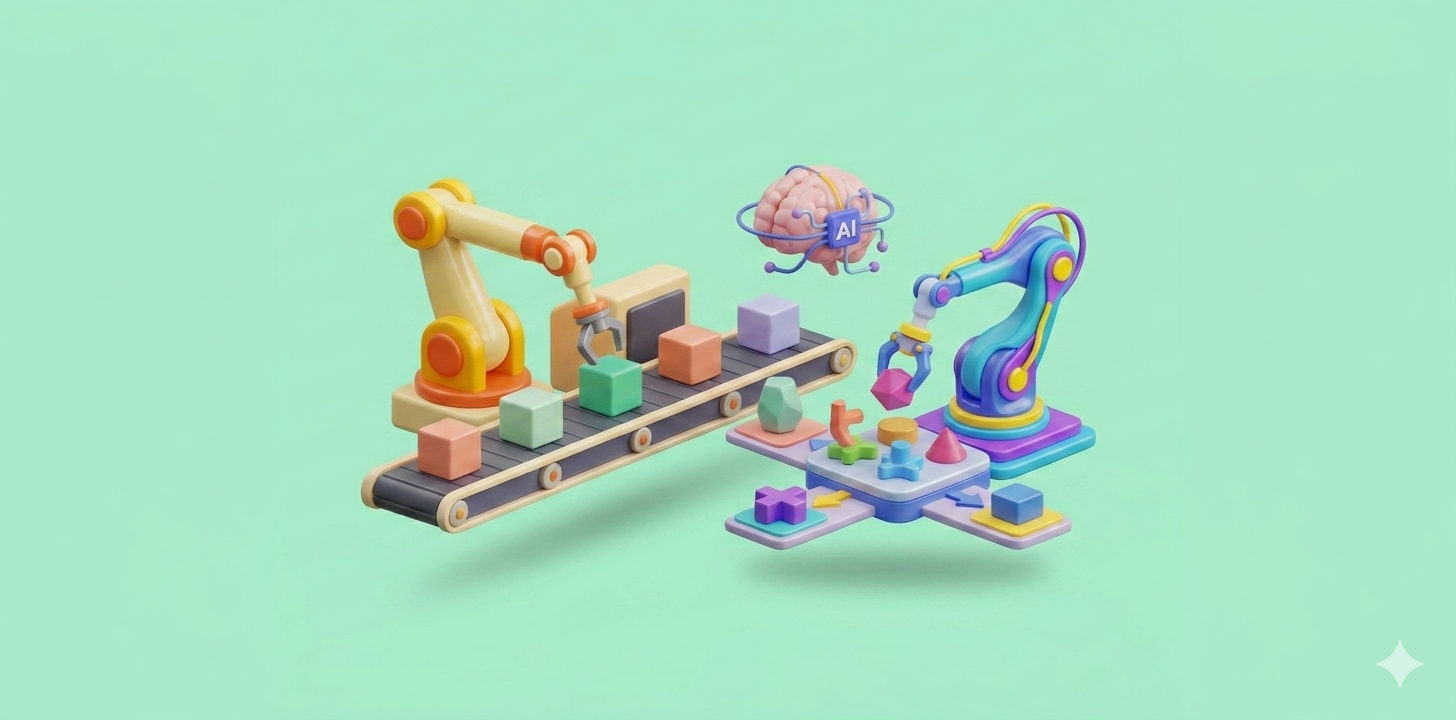
Rule-based systems strictly follow a manual handbook of instructions, while learning-based systems improve their performance over time by identifying patterns in data.
Rule-based logic is easier to control but fails when it hits an unexpected situation; learning-based logic allows a system to handle “gray areas” by predicting the most likely correct outcome based on its training.
- Example: A rule-based system might flag an order as “fraud” only if it exceeds $500. A learning-based system would look at the user’s location, time of day, and browsing history to spot suspicious behavior even on a small purchase.
How Do Traditional Automation and AI Automation Handle Data Differently?
Traditional automation requires “structured data” (clean spreadsheets and specific inputs), while AI can process “unstructured data” like images, human speech, or paragraphs of text.
AI acts as a translator, turning messy, real-world information into something usable, whereas traditional tools simply move pre-organized data from one place to another.
Does Traditional Automation or AI Automation Provide More Predictable Results?
Traditional automation is significantly more predictable because the output is an exact mirror of its programming.
Because AI is probabilistic (it calculates the most likely answer), it can occasionally produce “hallucinations” or unexpected results, making it less predictable but more flexible than rigid code.
- Decision Factor: Choose traditional methods for accounting or manufacturing where 100% repetition is required. Choose AI for marketing or design where uniqueness is valued.
Is AI Automation More Complex to Implement and Maintain Than Traditional Systems?
Yes, AI is technically more complex to build and requires high-quality data to “learn,” but it is often much simpler for the end-user to operate.
While a traditional system might require a human to manually update rules every time a business changes, an AI system can often recalibrate itself to match new trends or user preferences.
How Does the Role of the Human Operator Change When Moving to AI-Driven Systems?
The human role shifts from being the “doer” of a task to the “editor” or “strategist” who oversees the system’s results.
Instead of spending hours on technical execution, humans use their intuition to guide the AI, focusing on high-level goals rather than the buttons and gears.
Focus on improving your “prompting” skills; the more clearly you can describe your goal to an AI, the better it can perform the manual labor for you.
Which Industries Benefit Most from AI Automation Over Traditional Methods?
Industries that deal with high-volume creativity, complex predictions, or customer interaction—like healthcare, finance, and digital marketing—benefit the most.
These sectors involve too many variables for a human to write “rules” for every possible outcome, so they rely on AI to handle the nuances of human behavior and complex data.
What is the Future of Automation: Will AI Eventually Replace Traditional Methods?
AI will not replace traditional automation; instead, the two will merge into “hybrid” systems where traditional code provides the stability and AI provides the intelligence.
Traditional automation is too cost-effective and reliable for simple tasks to be discarded, so the future lies in using AI as an “intelligent layer” on top of existing automated foundations.
Conclusion
The choice between traditional and AI automation depends on whether your goal is rigid consistency or intelligent adaptation. While traditional methods remain the gold standard for repetitive, rule-based tasks, AI tools like Hocoos are redefining efficiency by handling the creative and complex logic that once required manual human effort. By integrating both, you can build a stable yet flexible workflow that scales with your business needs.